Weidenfeld-Hoffmann Scholarship 2027–28: Fully Funded Master's at Oxford With a Leadership Programme
Offered by University of Oxford and the Weidenfeld-Hoffmann Trust
Deadline not stated
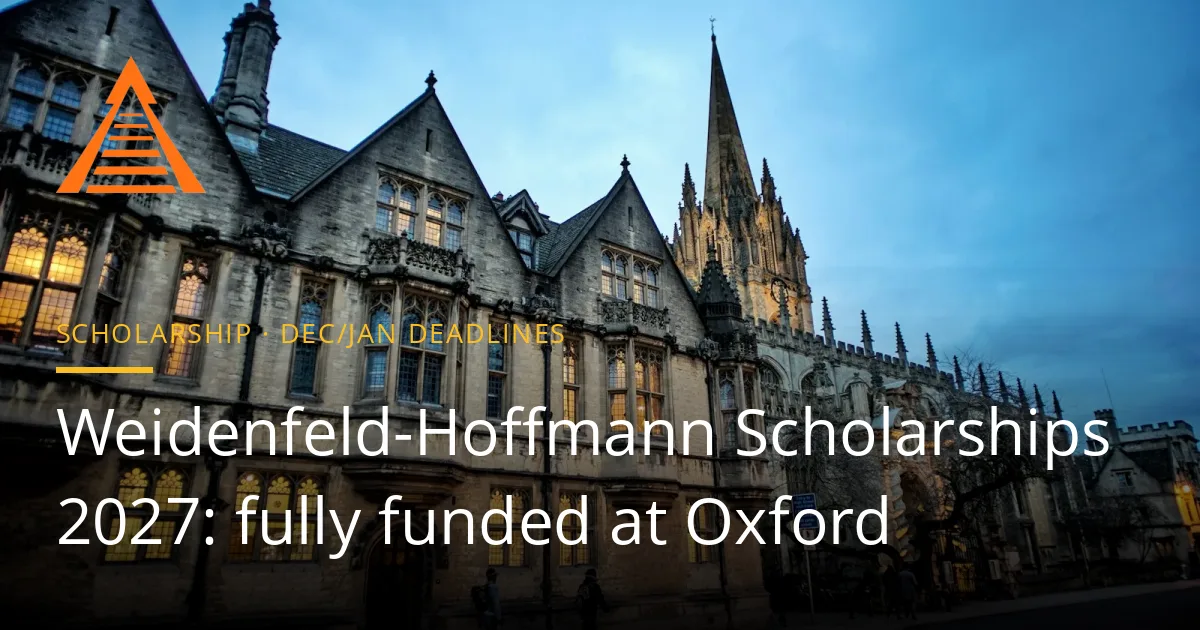
The Weidenfeld-Hoffmann Scholarship pays full Oxford fees plus at least £21,805 a year for graduates from developing countries. Apply by your course deadline.
The Weidenfeld-Hoffmann Scholarship is one of the few Oxford awards built for people from developing and emerging economies who plan to go home and work in public life. For 2027–28 it pays 100% of course fees and a living-costs grant of at least £21,805, according to the University of Oxford's official scholarship page. Applications go in with your Oxford graduate application, so the real deadline is your course deadline in December 2026 or January 2027.
Here is what the award covers, who can apply, which courses qualify and how to put together an application that stands a chance.
What the Weidenfeld-Hoffmann Scholarship pays for
Oxford lists three parts to the award:
- Full course fees for the agreed course, for the whole period you are liable for fees.
- A living-costs grant of at least £21,805.
- A place on the year-long Weidenfeld-Hoffmann Leadership Programme.
The Leadership Programme is what sets this scholarship apart from a plain fee waiver. Oxford describes it as a mix of philosophical discussion, business skills, communication training, long-term mentoring and networking. Scholars are also moved to a partner college that contributes part of the funding.
The programme started in 2015 and was expanded in 2017. Oxford says the University pays 40% of the cost and donors to the Weidenfeld-Hoffmann Trust pay 60%. The page does not say how many awards are made each year, so treat it as competitive.
Who can apply
Oxford's eligibility rules are short but strict. You must:
- Be ordinarily resident in one of the eligible countries. The official list runs to about 180 countries and includes most of Africa.
- Be applying to start a new full-time graduate course at Oxford in 2027–28.
- Be unable to pay for Oxford study without the scholarship.
- Intend to return to your country of ordinary residence after the course.
- Show how your subject links to your long-term career and how your work will improve public life at home, in your region or internationally.
Two groups are excluded. People holding a deferred offer to start in 2027–28 cannot apply, and current Oxford students are not eligible unless they already hold a Weidenfeld-Hoffmann award. Refugees and displaced applicants can apply if their nationality meets the country rules.
One warning for Afghan nationals: Afghanistan is on the list, but Oxford notes a UK government restriction on student visas for Afghan citizens. A separate scheme for Afghan women, funded by a £1.9 million gift from Shabana Basij-Rasikh, is due to publish its process by early November 2026.
Eligible courses
The scholarship is tied to a fixed list of one-year and two-year master's courses. Oxford groups them like this:
- Law: BCL and MJur.
- Business and policy: MBA, MPP, MSc Financial Economics, MSc Economics for Development, MSc Law and Finance, MSc Global Governance and Diplomacy, MSt Diplomatic Studies and two social policy MScs.
- Area studies: MSc African Studies plus Asian, Middle Eastern, Chinese, Latin American, South Asian, Russian and East European, Islamic and Jewish studies courses.
- Education: MSc Education in three pathways.
- Health: MSc International Health and Tropical Medicine, MSc Global Health Science and Epidemiology and two more.
- Environment and energy: MSc Energy Systems, MSc Environmental Change and Policy, MSc Water Science, Policy and Management and others.
- Migration and criminology: MSc Migration Studies, MSc Refugee and Forced Migration Studies, MSc Criminology and Criminal Justice.
- Computing and data: MSc Advanced Computer Science, MSc Social Data Science, MSc Social Science of the Internet and MSc Mathematical Modelling and Scientific Computing.
Check the full list on the official page before you choose. A course that is not on it cannot carry this award, however strong your profile.
Deadlines: why your course date matters
There is no single scholarship deadline. You apply by the December or January deadline of your chosen course, and the course page on Oxford's site gives the exact date. Several directories quote 6 January 2027, but that is only one of the January dates, so do not rely on it.
Oxford is clear on one trap. If your course application is held over to the March deadline or placed on a waiting list, it will not be considered for this scholarship. Submit early.
After that, shortlisted applicants are likely to be interviewed online in April 2027, and decisions are expected by the end of May 2027. If you hear nothing by then, Oxford says the application was unsuccessful, and it does not give individual feedback.
How to apply, step by step
- Choose an eligible course and write down its deadline.
- Start the Oxford graduate application and tick the Weidenfeld-Hoffmann Scholarships and Leadership Programme in the University of Oxford Scholarships section.
- Download the Weidenfeld-Hoffmann Scholarships Statement 2027/28 (a short Word form) from the official page.
- Answer it with specifics: the problem you want to work on at home, what you have already done about it and why this course is the missing piece.
- Upload the statement with the rest of your course application before the deadline.
Applying also counts as consent to be considered for Oxford's partnerships with the Oxford Pakistan Programme and Chevening. Chevening has its own application, and you would need to list Oxford as your first choice there.
Tips for a stronger statement
- Name a real public problem in your country and the role you want to play in fixing it.
- Show a track record: a job, a community project, research or policy work.
- Explain why you would return home. The selectors take this rule seriously.
- Keep it plain and specific. A clear five-year plan beats a list of adjectives.
If Oxford is your target, also look at the Clarendon Scholarship 2027 at Oxford. Many applicants are considered for both through the same graduate form.
Official page and application details: University of Oxford, Weidenfeld-Hoffmann Scholarships and Leadership Programme.
How to apply
- Pick an eligible full-time graduate course and note its December or January deadline on the Oxford course page.
- In the Oxford graduate application form, select the Weidenfeld-Hoffmann Scholarships and Leadership Programme under University of Oxford Scholarships.
- Download and complete the Weidenfeld-Hoffmann Scholarships Statement 2027/28 from the official page.
- Upload the statement with your graduate application before your course deadline.
- If shortlisted, attend an online interview, likely in April 2027.
What you will need
- Personal statement
- Recommendation letters
- Transcripts
- CV or résumé
- Other
Eligibility notes
Mainly for graduates and professionals from developing and emerging economies who are ordinarily resident in one of about 180 eligible countries listed by Oxford. You must intend to return to your country of ordinary residence after the course and be unable to fund Oxford study without the award. Not open to holders of deferred offers for 2027-28 or to current Oxford students (unless already Weidenfeld-Hoffmann scholars).
Details can change without notice. Confirm everything on the organisation's own page before you apply — see our disclaimer. Spotted something out of date? Tell us.