Clarendon Scholarship 2027 at Oxford: Fully Funded Master's and DPhil
Offered by Clarendon Fund, University of Oxford
Deadline not stated
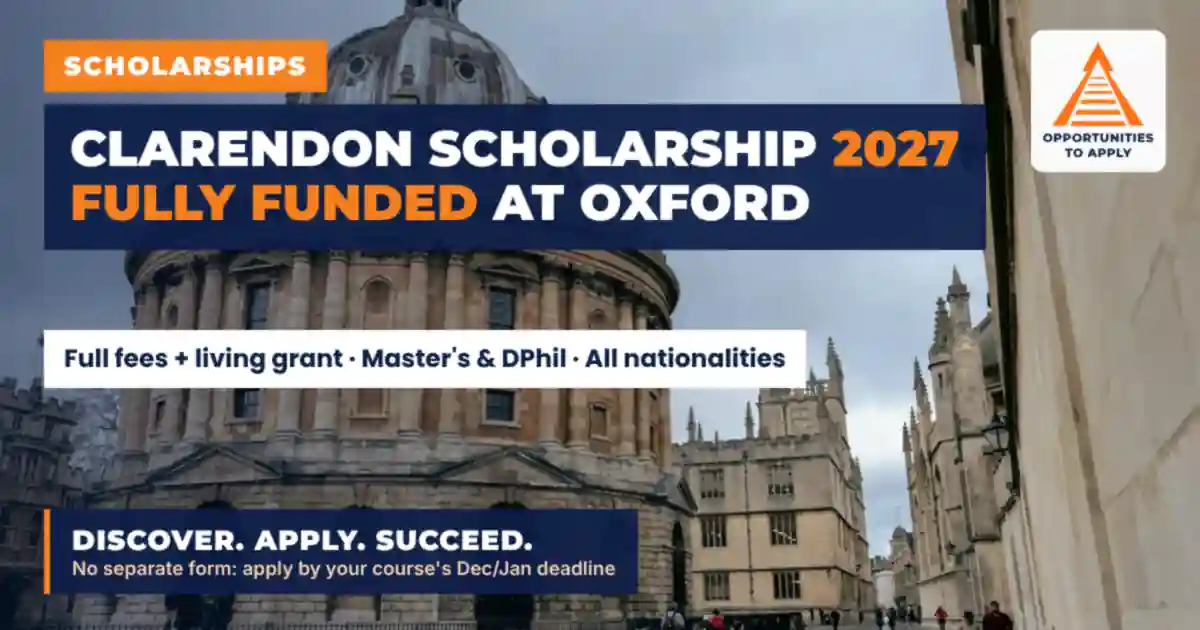
The Clarendon Scholarship pays full Oxford fees plus a living grant for graduate study. There is no separate form: apply for your course by its deadline.
The Clarendon Scholarship is the University of Oxford's flagship graduate award. It pays full course fees and a living grant for master's and doctoral (DPhil) students, and it is open to applicants of any nationality. The Clarendon Scholarship has run since 2001, and the 2025/26 cohort was its 25th intake, according to the Clarendon Fund.
The most important detail for applicants is that there is no separate scholarship form. You are considered automatically when you apply for an eligible Oxford graduate course by its funding deadline.
What the Clarendon Scholarship covers
According to the official applicants page, each award includes:
- Full university course fees
- A grant for living costs set at no less than the UK Research and Innovation (UKRI) minimum doctoral stipend. For 2025-26 that was at least £20,780 a year.
The 2027 rate has not yet been announced, so treat the 2025-26 figure as a guide rather than a promise.
Part-time students
Part-time students on eligible courses can also be considered. Their living grant is reduced pro rata: one sixth, one third or one half of the full-time amount, depending on the course.
How many scholarships are awarded
The fund offers more than 200 new scholarships each year. At any one time, more than 700 Clarendon Scholars are on course, drawn from about 70 countries, according to Oxford.
Who can apply
The scholarship has no restrictions on nationality, country of residence or subject. Applicants from Africa, Asia, Latin America and everywhere else compete on the same terms as UK students.
A few groups are excluded:
- Applicants with a deferred offer of admission
- Current Oxford students continuing on the same degree
What selectors look for
Selection is based on academic excellence and potential. Oxford says most successful candidates hold, or are expected to receive, a first-class undergraduate degree or a GPA of 3.7 out of 4.0. Your references, statement of purpose and, for research degrees, your research proposal all feed into that judgement.
How to apply
- Pick a graduate course at Oxford and confirm on the Clarendon page that it is eligible.
- Find the course's funding deadline on its page. These fall in December or January depending on the course.
- Submit your full graduate application by that deadline, including transcripts, references, a statement of purpose and any research proposal the course asks for.
- Do not look for a separate Clarendon form. There isn't one.
Missing the December or January deadline for your course means you will not be considered for Clarendon funding, even if you are later admitted.
Deadline and timeline
Oxford does not set a single Clarendon deadline. Each course has its own date in December or January, so check your course page for the exact one. We have not listed a date here because it varies by programme.
After the deadline, the process usually runs like this, according to Oxford:
- Shortlisting takes place in February and March.
- Most scholarship offers are made by the end of April.
- If you have not heard by mid-June, you should assume your application for Clarendon funding was unsuccessful.
Tips for a stronger application
Because Clarendon decisions ride on your course application, the best preparation is a strong academic file. Ask referees early so they have time to write detailed letters. Make your statement of purpose specific to the course and the academics you want to work with. For a DPhil, a clear and realistic research proposal carries a lot of weight.
Apply early in the cycle where you can. It gives you room to fix missing documents before the funding deadline.
Similar awards
If you are applying to UK universities, also look at the Gates Cambridge Scholarship 2027, which funds master's and PhD study at Cambridge. Many applicants apply to both.
Key facts at a glance
- Host: University of Oxford, United Kingdom
- Level: Master's and DPhil
- Funding: Full fees plus living grant (at least £20,780 in 2025-26)
- Eligibility: All nationalities and subjects
- How to apply: Apply for your course by its December or January deadline
- Official page:ox.ac.uk Clarendon applicants
How to apply
- Choose an eligible full-time or part-time graduate course at Oxford.
- Submit your graduate application by the December or January funding deadline listed on your course page.
- Upload transcripts, references, your statement of purpose and any research proposal your course requires.
- There is no separate Clarendon form: every eligible applicant who meets the course deadline is considered automatically.
- Wait for shortlisting in February and March; most offers are made by the end of April.
What you will need
- Transcripts
- Recommendation letters
- Personal statement
- Research proposal
Details can change without notice. Confirm everything on the organisation's own page before you apply — see our disclaimer. Spotted something out of date? Tell us.