Atlantic Fellows for Social and Economic Equity 2027–28 at LSE: Fully Funded Fellowship for Inequality Leaders, Deadline 11 January
Offered by Atlantic Fellows for Social and Economic Equity, International Inequalities Institute, London School of Economics and Political Science
11 Jan 2027
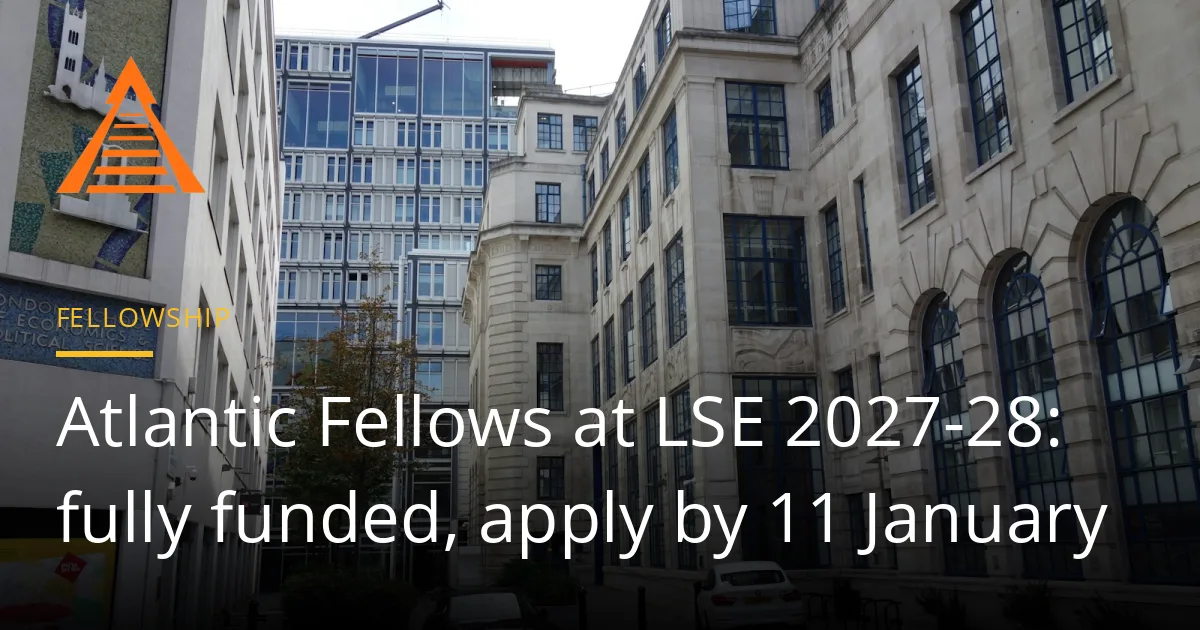
The Atlantic Fellows for Social and Economic Equity programme at LSE is open for 2027-28. Fully funded, for leaders with 7+ years' experience. Apply by 11 Jan.
The Atlantic Fellows for Social and Economic Equity (AFSEE) programme at the London School of Economics is now taking applications for its 2027–28 cohort. It is a fully funded fellowship for mid-career people working against inequality, and the deadline is 5pm UK time on 11 January 2027. Late applications are not accepted.
LSE announced the call on 9 October 2026. This will be the programme's eleventh cohort. Since it started in 2016, AFSEE has brought in more than 160 fellows from 60 countries, and it aims to build a community of 400 fellows over two decades.
What the Atlantic Fellows fellowship offers
Applicants choose one of two tracks.
Residential track
- One year in London.
- Study for the MSc in Inequalities and Social Science at LSE.
- Four fellowship modules: foundations of social and economic inequalities, policy for equity, challenging and transforming inequality, and debates around inequality.
Non-residential track
- Stay in your home country and current job during the fellowship year.
- Run a practice-based project.
- Join the residential fellows for the modules, online and in person.
- Earn a Postgraduate Certificate in Social and Economic Equity at the end of the year.
After the active year, every fellow becomes a Senior Fellow in the wider Atlantic Fellows community, which spans seven programmes worldwide and is supported by the Atlantic Institute at the Rhodes Trust in Oxford. LSE says Senior Fellows can access funding for professional development and joint projects.
LSE describes the programme as fully funded. Its published pages do not give stipend or travel amounts, so check the FAQ or email the team if you need exact figures before applying.
Who can apply
The fellowship is open to people anywhere in the world. LSE lists policymakers, researchers, activists, practitioners, artists and movement-builders among the people it wants to hear from. You need:
- At least seven years of experience challenging inequalities, for both tracks.
- English good enough to meet LSE's requirements. You do not need to sit a test before applying.
- For the residential track only: eligibility for admission to the MSc in Inequalities and Social Science.
A degree is not strictly required to apply. The application asks for transcripts, or a document stating that you do not hold an undergraduate degree.
Eligible areas of work are broad. LSE names economic and social rights, environmental justice, tax justice, women's, minority and disability rights, education, housing, labour rights, community organising, arts and culture, and peacebuilding.
How you will be judged
The selection criteria focus on three things:
- Who you are, your values and your track record of challenging inequality.
- The clarity of your vision and the impact you want to have.
- Your readiness to learn from, and contribute to, the AFSEE community.
Professor Armine Ishkanian, AFSEE's executive director, describes the fellowship as "a unique opportunity for change-makers" to step back and refocus their work.
Documents you need
- Online application through LSE's Graduate Application System
- CV
- Statement of academic purpose
- Transcripts, or a statement that you have no undergraduate degree
- Two references, both submitted by the reference deadline
- Proof of English language eligibility
Incomplete applications are not considered. LSE advises starting early, because universities that hold your transcripts may close over the winter break.
Key dates
- 7 October 2026: applications opened
- October–November 2026: Q&A sessions with AFSEE ambassadors
- 16 November 2026: application tips webinar
- November–December 2026: weekly Zoom drop-in sessions
- 11 January 2027, 5pm UK time: applications close
- Mid-March 2027: interview invitations
- Mid-April 2027: final decisions
- Mid-July 2027: new cohort announced
Tips for a strong application
- Show concrete results from your seven-plus years: campaigns run, policies changed, communities reached.
- Be specific about what you will do differently after the fellowship.
- Pick referees who have seen your work up close and give them plenty of time.
- Use the free webinars and drop-in sessions to ask questions directly.
Looking for more funded calls with deadlines in the next three months? See our roundup of fellowship and scholarship deadlines before February 2027.
Official application page:afsee.atlanticfellows.lse.ac.uk/en-gb/apply. Questions: afsee@lse.ac.uk.
How to apply
- Read the eligibility and selection criteria on the AFSEE website.
- Choose the Residential or Non-residential track.
- Apply online through LSE's Graduate Application System from the AFSEE apply page.
- Upload your CV, statement of academic purpose, transcripts (or a note that you have no undergraduate degree) and proof of English language eligibility.
- Arrange two references and make sure both arrive by the reference deadline.
- Submit before 5pm UK time on 11 January 2027.
What you will need
- CV or résumé
- Personal statement
- Recommendation letters
- Transcripts
- Language test result
Eligibility notes
Open worldwide. Applicants need at least seven years of experience challenging inequalities and must meet LSE's English language requirements (no test is needed before applying). Residential track applicants must qualify for admission to the LSE MSc in Inequalities and Social Science. Applicants without an undergraduate degree can submit a document saying so in place of transcripts.
Questions about the programme: afsee@lse.ac.uk (shown as the organisation published it — we do not handle applications).
Details can change without notice. Confirm everything on the organisation's own page before you apply — see our disclaimer. Spotted something out of date? Tell us.