Amelia Earhart Fellowship 2027: US$12,000 for Women PhD Students in Aerospace Engineering and Space Sciences, Deadline 15 November
Offered by Zonta International
Closes in 14 days — 15 Nov 2026
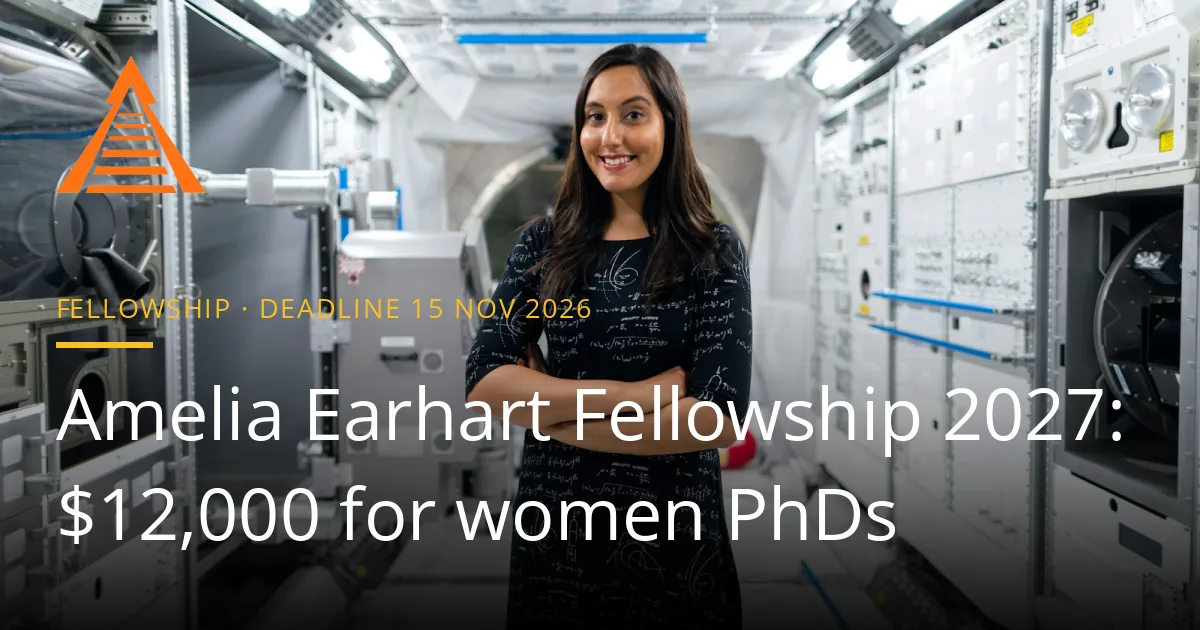
The Amelia Earhart Fellowship 2027 gives up to 30 women PhD students in aerospace engineering or space sciences US$12,000 each. Apply by 15 November 2026.
The Amelia Earhart Fellowship 2027 is open to women doing a PhD in aerospace engineering or space sciences anywhere in the world. Zonta International will give up to 30 Fellows a US$12,000 award each. Applications close on 15 November 2026 and are submitted online only.
The fellowship has run since 1938, which makes it one of the oldest awards for women in aerospace. Zonta's 2027 programme overview says it has awarded 1,824 fellowships worth more than US$12.5 million to 1,395 women from 81 countries.
Amelia Earhart Fellowship 2027 at a glance
- Award: US$12,000 per Fellow
- Number of awards: up to 30
- Who: women of any nationality in a full-time PhD or doctoral programme
- Fields: aerospace engineering and space sciences
- Deadline: 15 November 2026 (Zonta does not state a time zone, so submit early)
- Where to apply: Zonta International's AwardSpring portal
Who can apply
According to Zonta International, you must:
- be a woman, of any nationality;
- be enrolled full time in a PhD or doctoral programme in aerospace engineering or space sciences, with research in that field;
- have a strong academic record;
- have completed at least one year of your doctoral programme, or already hold a master's degree in an aerospace-applied field, at the time you apply;
- not expect to graduate before April 2028.
You cannot apply if you are a postdoctoral researcher or if you have held an Amelia Earhart Fellowship before. Since 2016, past Fellows can no longer renew for a second year.
Does my field count?
"Aerospace-applied" is broader than rockets and aircraft. Research that sits in space science and engineering departments, such as propulsion, materials, satellites, planetary science or remote sensing, can qualify if it applies directly to aerospace or space. Make the link clear in your research summary rather than assuming reviewers will see it.
What the fellowship gives you
The award is a US$12,000 grant. Zonta does not describe it as covering tuition, housing or travel, so think of it as flexible support for your doctoral work and living costs rather than a full scholarship. Fellows also join a network of more than 1,800 past recipients across 81 countries, and one Fellow each year is named the Sharon Langenbeck Amelia Earhart Fellow, in honour of a two-time Fellow and former Zonta International President.
How to apply
- Go to zontainternational.awardspring.com and create an account.
- Fill in the online form on your academic background, professional goals and research programme.
- Add three referees, academic or professional, who can speak to your research.
- Upload detailed transcripts from every university or college you have attended.
- Submit everything by 15 November 2026. Zonta does not accept paper or email applications.
Tips for a strong application
- Ask referees now. Three letters in under four weeks is tight. Give referees a short summary of your research and the deadline.
- Explain your research for a mixed panel. Say what problem you are solving, why it matters for aerospace or space, and what you have already achieved.
- Show your goals. Zonta asks about your professional plans. Be specific about where you want your career to go.
- Get transcripts early. Universities in many African countries take weeks to issue official transcripts. Request them today.
- Check eligibility dates. If you expect to finish your PhD before April 2028, you are not eligible.
Why African researchers should look at this
Space programmes are growing across the continent, from satellite work in Nigeria, Egypt, Kenya and South Africa to the African Space Agency in Cairo. Women doing doctoral research in these fields, whether at African universities or abroad, are eligible on the same terms as everyone else. The award is open to any nationality, and there is no restriction on where you study, as long as you are in a full-time doctoral programme.
Looking for more funding for doctoral study? See our listing for the Hong Kong PhD Fellowship Scheme 2027/28, which closes on 1 December.
Source: Zonta International, Amelia Earhart Fellowship 2027 programme overview and zonta.org/AEFellowship. Always confirm details on the official site before applying. Photo: ThisisEngineering / Unsplash.
How to apply
- Create an account on Zonta International's AwardSpring portal (zontainternational.awardspring.com).
- Complete the online form on your academic background, professional goals and research programme.
- Request three references from academic or professional referees through the portal.
- Upload detailed transcripts from every university or college you have attended.
- Submit the complete application by 15 November 2026. Hard-copy and email applications are not accepted.
What you will need
- Recommendation letters
- Transcripts
- Research proposal
- Other
Eligibility notes
Open to women of any nationality enrolled full time in a PhD or doctoral programme in aerospace engineering or space sciences. At application you must have completed at least one year of the programme or hold a master's degree in an aerospace-applied field, and you must not graduate before April 2028. Postdoctoral researchers and previous Amelia Earhart Fellows cannot apply.
Questions about the programme: https://zonta.org/AEFellowship (shown as the organisation published it — we do not handle applications).
Details can change without notice. Confirm everything on the organisation's own page before you apply — see our disclaimer. Spotted something out of date? Tell us.