
UNESCO Research Continuity Grants for Africa 2026: Up to $2,000 for Scientists Whose Work Was Disrupted by Conflict or Disaster
Offered by United Nations Educational, Scientific and Cultural Organization (UNESCO), Science for Crisis Response and Solutions (SCRS) Programme
Closes in 14 days — 15 Nov 2026
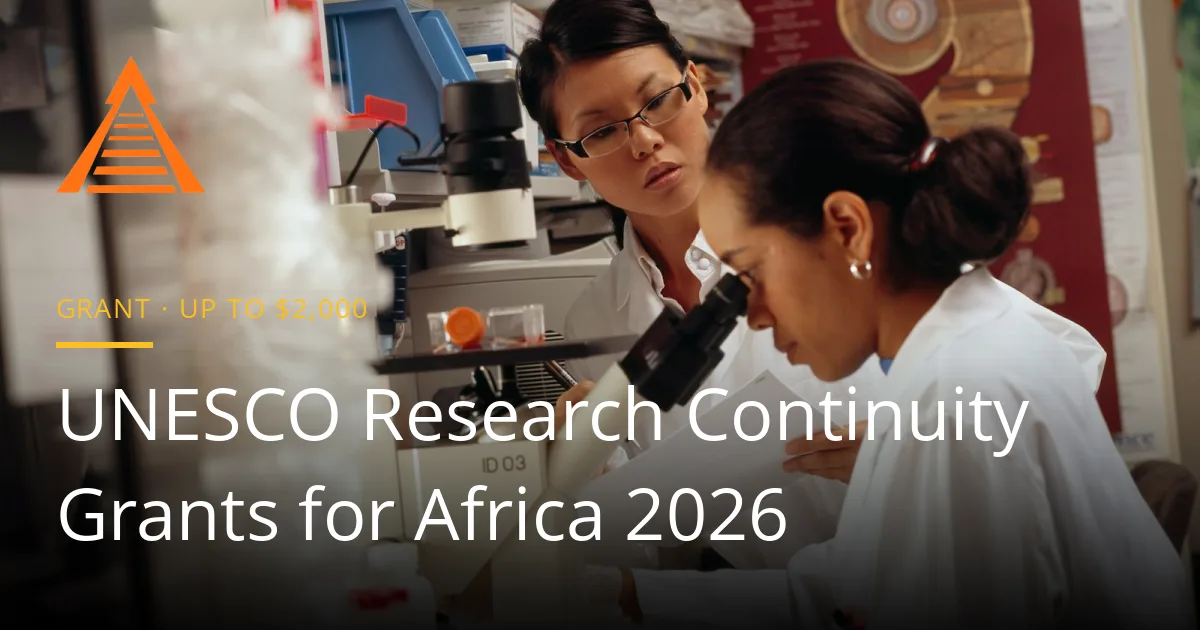
UNESCO research continuity grants give African natural scientists up to USD 2,000 to restart work halted by conflict or disaster. Deadline 15 November 2026.
UNESCO research continuity grants are now open for African scientists whose work was stopped by war, floods, drought, disease outbreaks or other disasters. Under its Science for Crisis Response and Solutions (SCRS) Programme, UNESCO will award six grants of up to USD 2,000 each to help researchers resume or finish natural-science projects. The deadline is 15 November 2026, 23:59 Paris time.
The amount is small, but it is aimed at a real gap. A broken piece of lab equipment, a cancelled field trip or lost samples can stall a thesis or a research project for years. This grant pays for exactly those things.
UNESCO research continuity grants at a glance
- Organiser: UNESCO, SCRS Programme
- Amount: up to USD 2,000 per grant
- Number of grants: six, in this first pilot call
- Who: African nationals at African universities or research institutes
- Field: natural sciences, including interdisciplinary work with a strong natural-science component
- Project length: must be completed within six months
- Languages: apply in English or French
- Deadline: 15 November 2026, 23:59 Paris time
Who can apply
According to UNESCO's call, you must meet all of these conditions:
- You are a national of an African country.
- You are based at a recognised university or research institute in an African country.
- You hold at least a Master's degree or an equivalent recognised research qualification in a relevant field.
- Your research is in the natural sciences, or is interdisciplinary with a substantial natural-science component.
- Your research was interrupted by armed conflict or a natural or biological hazard within the previous three years, or is still materially affected by its consequences.
- The activities you propose can be completed within six months and within the USD 2,000 ceiling.
- You have a signed support letter from an authorised representative of your host institution.
- You confirm the same costs are not funded from another source.
UNESCO particularly encourages applications from women scientists, researchers under 40, and researchers from least developed countries and Small Island Developing States in Africa.
What the grant pays for
- Consumables and small research supplies
- Local fieldwork and research travel
- Data collection, processing or secure storage
- Minor equipment repair, or short-term access to equipment or facilities
- Laboratory, publication or open-access costs
What it does not pay for
Salary replacement, honoraria, personal allowances, international relocation, long-term subsistence, major equipment or construction, institutional overheads and activities unrelated to the interrupted research.
How to apply
- Go to the official UNESCO call page and read the Call for Applications, Terms of Reference and Concept Note.
- Complete and sign the application form, in English or French.
- Attach your CV, proof of your highest relevant qualification and the signed institutional support letter.
- Include any ethics, research or fieldwork permits your project requires.
- Submit online through the form on the UNESCO page before the deadline.
Tips for a strong application
- Show the disruption clearly. Explain what happened, when, and exactly how it stopped your work. Dates and specifics help.
- Keep the budget tight and itemised. List each cost and link it to a task. Reviewers need to see the project can finish within USD 2,000 and six months.
- Be realistic about outputs. A completed dataset, a submitted paper or a finished thesis chapter is a stronger promise than a vague goal.
- Get the support letter early. Institutional signatures often take longer than expected.
With only six grants in this pilot round, competition will be strong. If your work fits, apply early rather than on the last day. Looking for larger funding for a startup instead? See our listing for the Africa Energy Entrepreneurship Awards 2026.
Always confirm details on the official UNESCO page before applying. Opportunities to Apply does not process applications.
How to apply
- Read the Call for Applications, Terms of Reference and Concept Note on the UNESCO page.
- Complete and sign the application form in English or French.
- Attach your CV, proof of your highest relevant qualification and a signed support letter from your host institution.
- Add any ethics, research or fieldwork authorisations your project needs.
- Submit online through the form linked on the UNESCO page before 15 November 2026, 23:59 Paris time.
What you will need
- CV or résumé
- Transcripts
- Recommendation letters
- Other
Eligibility notes
Open to African nationals based at a recognised university or research institute in an African country. Applicants need at least a Master's degree or equivalent research qualification. The research must be in the natural sciences (or interdisciplinary with a substantial natural-science component) and must have been interrupted by armed conflict or a natural or biological hazard within the previous three years, or still be materially affected by it. Activities must be completed within six months. A signed support letter from the host institution is required. Applications in English or French. Women scientists, researchers under 40 and researchers from least developed countries and Small Island Developing States in Africa are particularly encouraged.
Details can change without notice. Confirm everything on the organisation's own page before you apply — see our disclaimer. Spotted something out of date? Tell us.